

Mosaic Class in Samarkand: Learn & Craft Uzbek Tiles
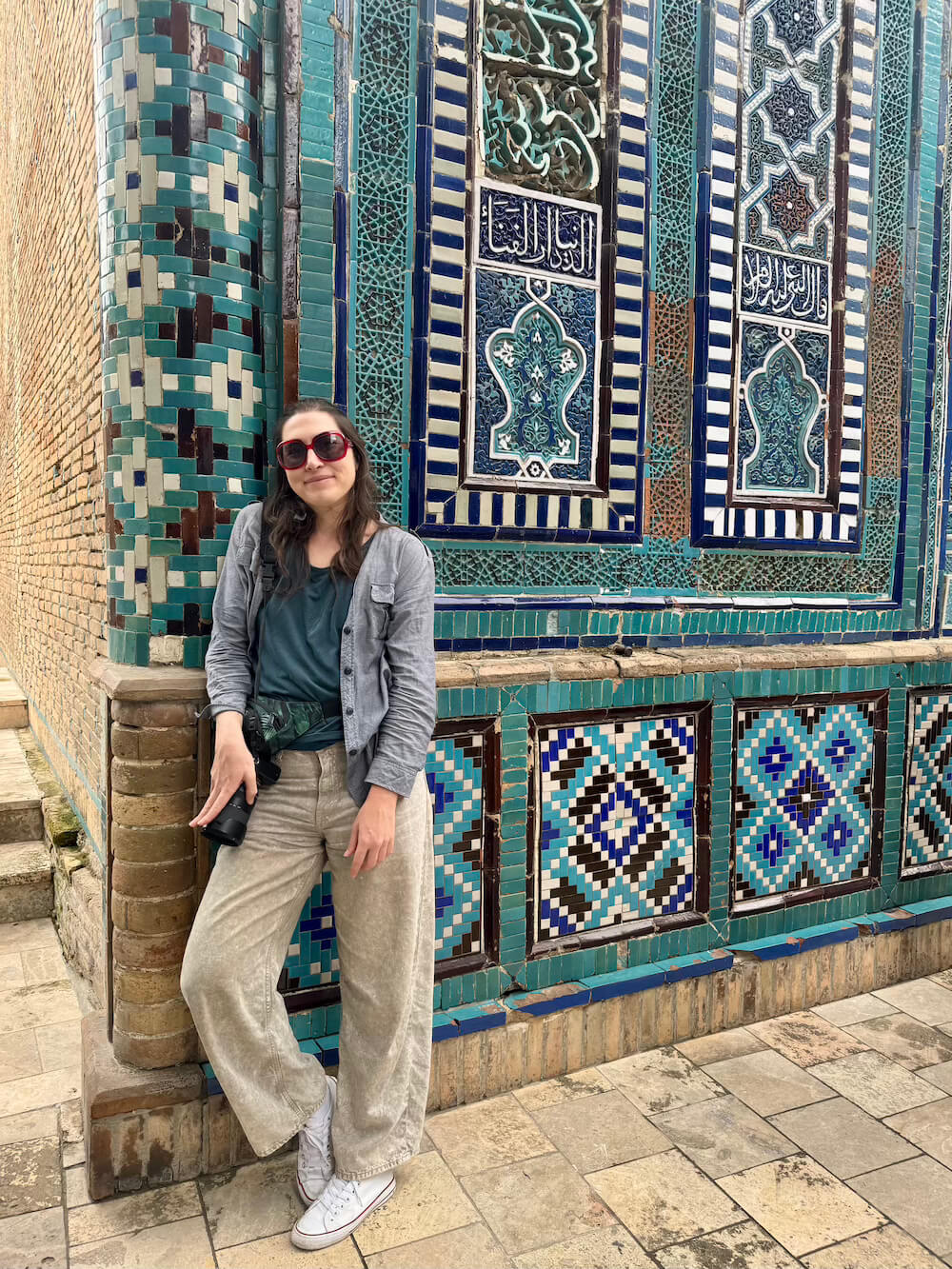
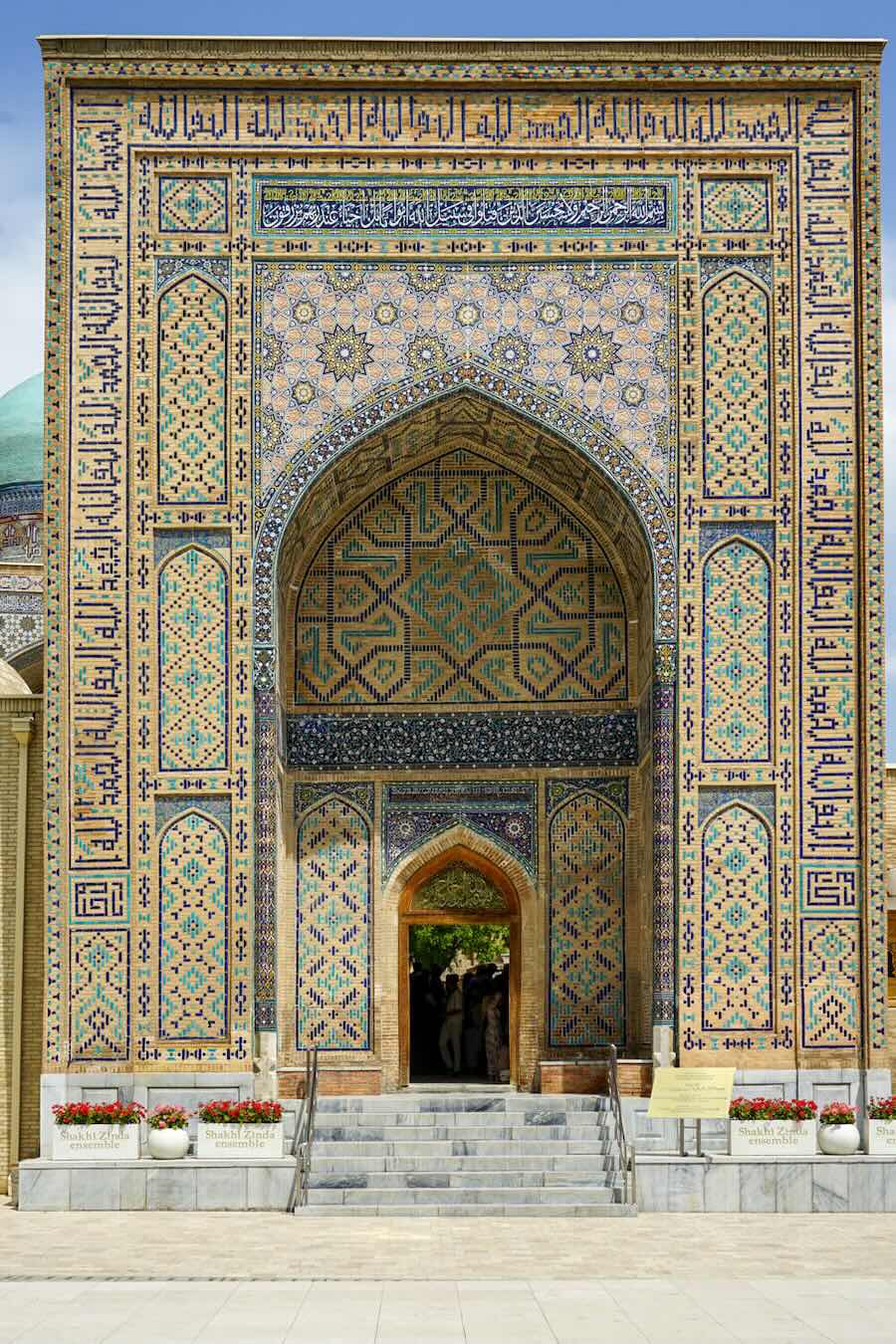
One of the main draws to Uzbekistan for many aesthetically inclined travelers — myself included — is its intricate tilework and mosaics in a monochrome rainbow of blues, ranging from pale turquoise to inky cobalt.
All over the country, mosaics and tilework are an important point of national pride and identity. And perhaps nowhere is that more true than in Samarkand, a city that is — for me, at least — will always be colored blue in my memories.
| 🇺🇿 Planning your trip to Uzbekistan in a hurry? Here are some quick picks: 🪡 Best Activities in Uzbekistan 1. Tashkent: Amirsoy, Chingan & Charvak Tour (nature outside of Tashkent) 2. Samarkand: Mosaic Workshop (learn the history of Uzbek tiles!) 3. Bukhara: Suzani Embroidery Workshop (best place to learn Uzbek crafts!) 4. Khiva: 4 Ancient Fortresses Day Tour (see Khorezm castles) 5. Nukus: Aral Sea excursion with yurt camp overnight (a must-do!) 🏨 Best Hotels in Uzbekistan 1. Tashkent: Home Boutique Hotel (comforts that feel like home!) 2. Samarkand: Zarafshon Parkside (5* luxury, great location) 3. Bukhara: Duston Boutique XIX Century Hotel (loved it!) 4. Khiva: Khiva Siyovush Hotel (lovely family-owned hotel!) 5. Nukus: Hotel Jipek Joli (super artsy & unique!) 🚄 Getting Around Uzbekistan: The best way is either by guided transfers that include sightseeing along the way (like this one, if you’re going from Bukhara to Khiva) or by train. If booking a train, you can first try the official website. If they’re sold out, check 12go.asia as they often have extra tickets at a small surcharge. |
I think of Samarkand and I flash back to turquoise domes, geometric mosaic reliefs, and mausoleum and madrasah façades of thousands of colorfully placed tiles.
For me, the architecture of Samarkand is inextricable and interconnected from the history of tilework and more specifically, the art of the mosaic. And so, of course, it made all the sense in the world to take a mosaic class in Samarkand.
Why Mosaics in Samarkand?
Samarkand, after all, was the main locus of the Timurid Renaissance. Italy wasn’t the only country to have an artistic renaissance, after all. Under the rule of Timur, his empire (vast, but with Uzbekistan at its heart) underwent a massive Islamic cultural and artistic revival.
Samarkand was Timur’s pet project, of sorts. He was born in Shahrisabz, 80 kilometers away, but he chose Samarkand specifically to turn into a cultural capital, an emblem of the riches of his empire.
During his rule, he revived certain Islamic traditions, particularly Persian art forms, such as the miniature painting, as well as the mosaic.
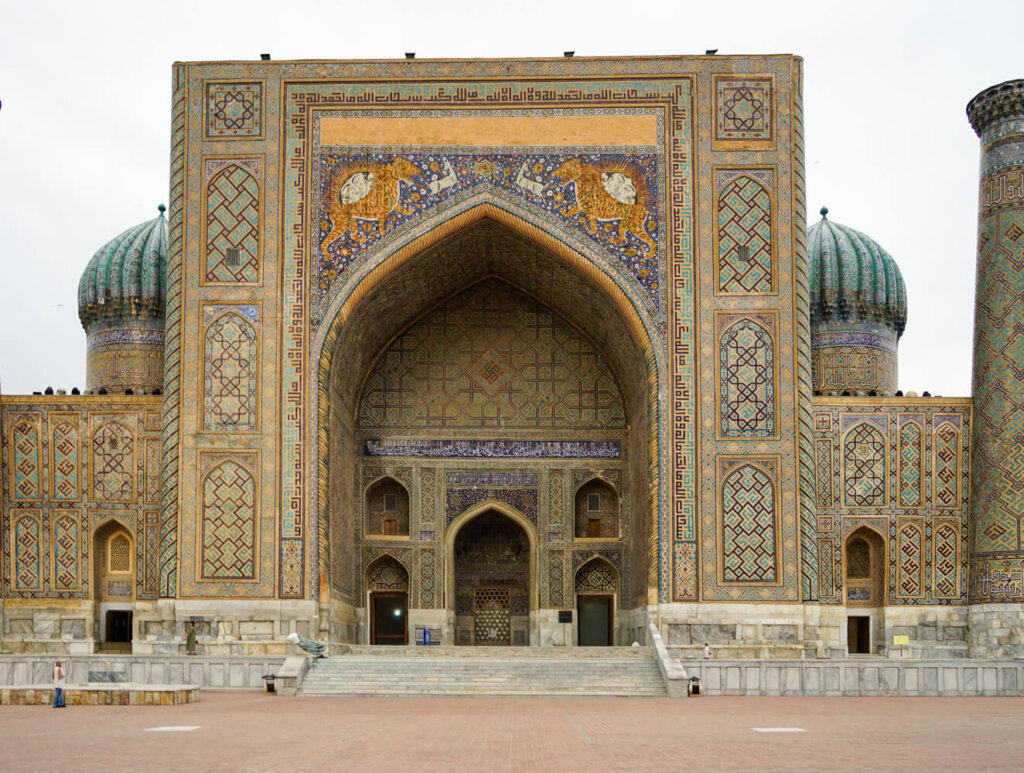
He was instrumental in the creation of enduring buildings such as the Registan — the icon of Samarkand and arguably the face of Uzbekistan itself– and Bibi-Khanym Mosque, one of my personal favorite spots in Samarkand, despite an earthquake leaving it a bit worse for wear.
Walking through Samarkand today, it’s impossible not to notice how often mosaic appears, and how indebted it is to Timur’s reign. The geometric patterns and blue tiles are Samarkand’s defining characteristic, and indeed, one of Uzbekistan’s.
Why Take a Samarkand Mosaic Class
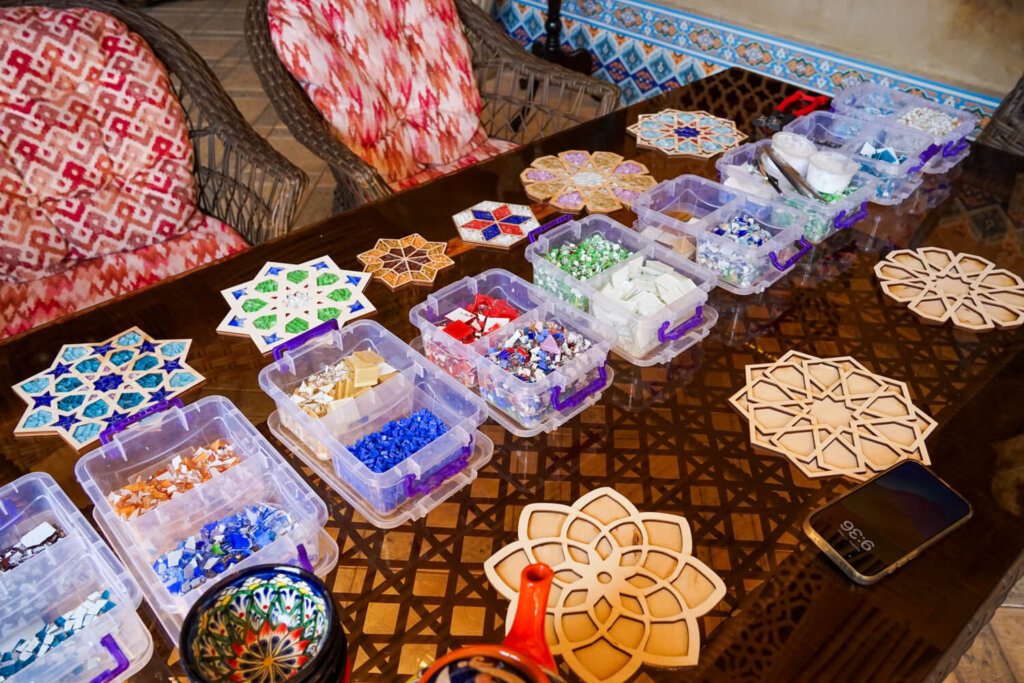
I figured, what better way to explore a city that was once the heart of a craft renaissance than by taking a mosaic class in Samarkand?
While you’re certainly not going to create a mosaic masterpiece comparable to the buildings of Samarkand in a single afternoon, you can create a small piece of mosaic art to take home with you, all in a single class!
I was actually surprised by how much I was able to do within the span of this workshop’s time frame.
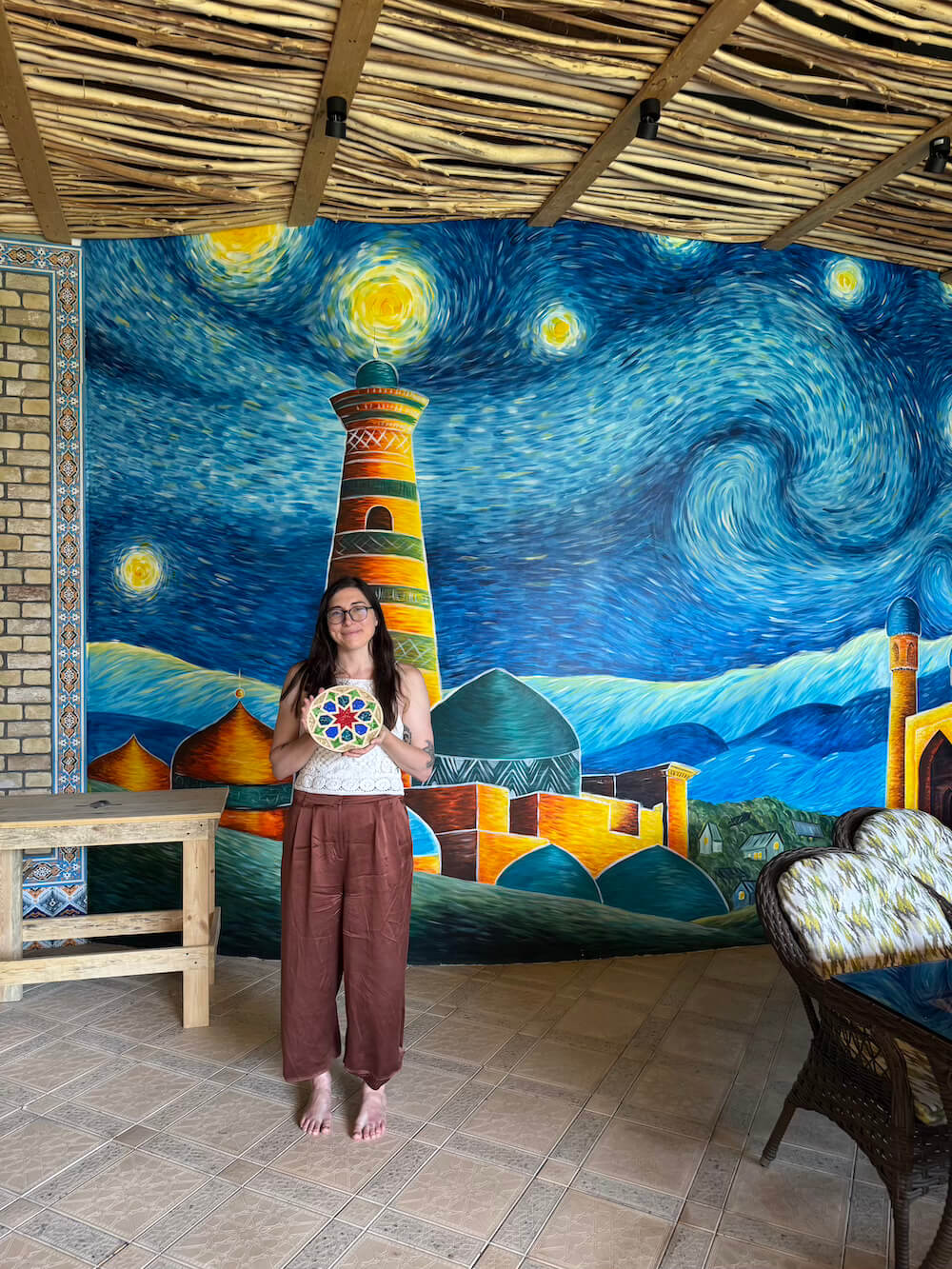
Even little old me, with my woeful crafting skills, was able to have a fully finished work to bring home (with a little help)… unlike the tiny portion of my suzani that will likely forever remain unfinished (even though I loved the class).
This sits in my home, right in my kitchen, always reminding me of my trip to Uzbekistan. For one price, you get three things: a learning experience from experienced local guides, a crafting workshop, and a beautiful one-of-a-kind souvenir you’ll always remember making.
The Workshop Experience
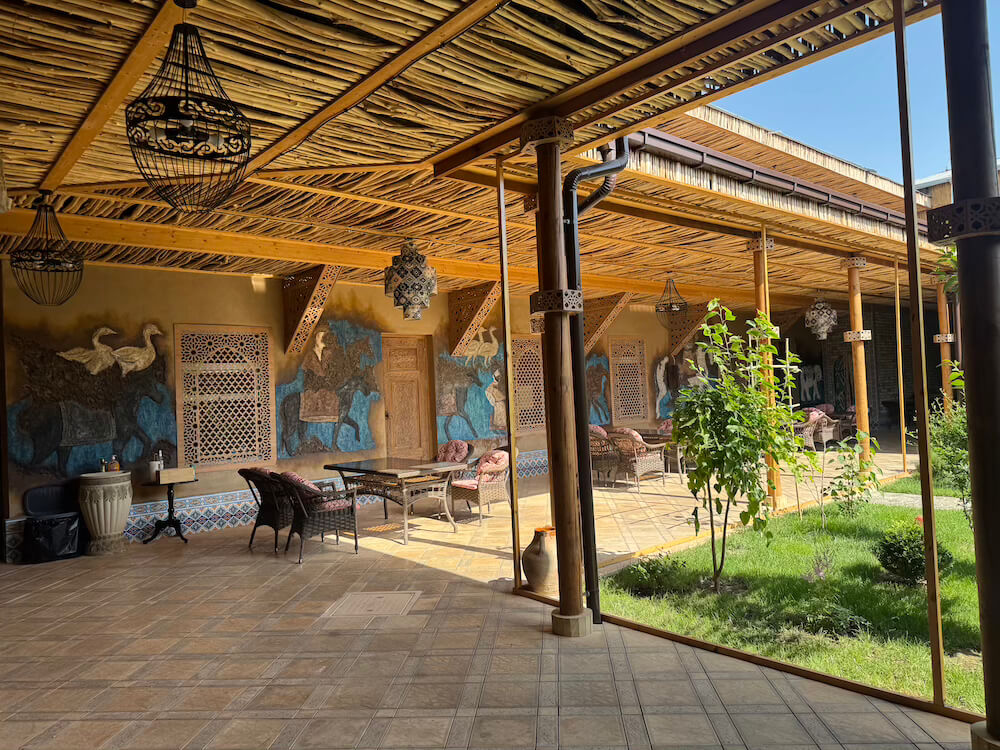
My friend and I were picked up right on time by our local guide, Timur (who went by Tim). He was super friendly and spoke great English, and he was going to help serve as a translator and give us more context for the crafting session.
We arrived at the workshop location, Traditions Square, which is home to a lot of different kinds of crafts (silk painting, ceramics, knife-making, etc.) which are all taught by various artisans. The company I took this tour with holds some workshops here, while others are being moved to the Eternal City, further outside the center of Samarkand.
We arrived and did a small tour of the grounds at Traditions Square before meeting our mosaic instructor for the day, Azamat. We met and chatted over Uzbek tea and sweets, including some delicious halva.
Azamat is a younger man from a family of artisans, but he’s the first in his family to become a mosaics master. He spoke rather good English, so we were all able to chat freely. If there was anything he couldn’t communicate, Tim bridged the gap.
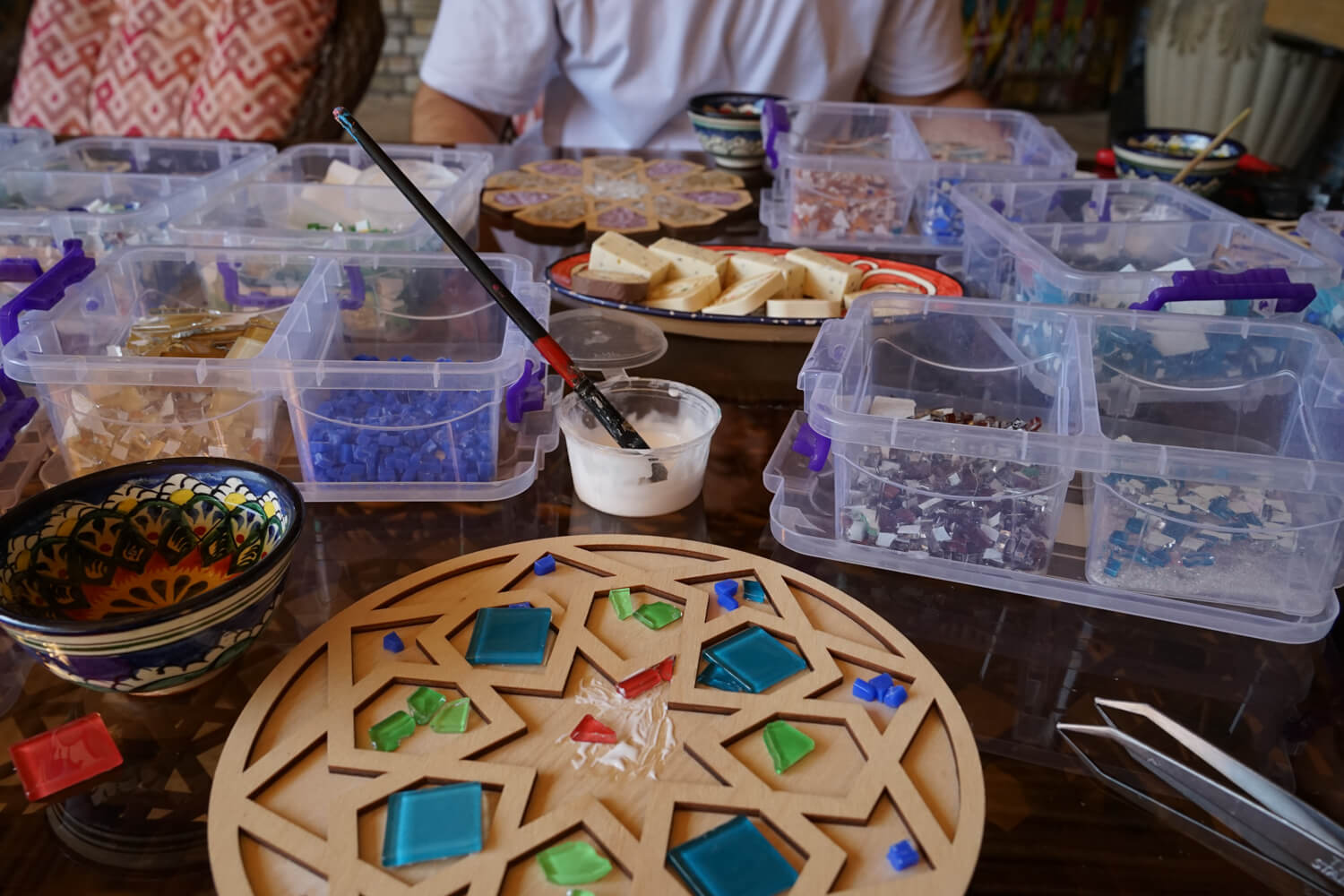
To make it possible to create your own mosaic piece in a single day, you are provided with several wooden molds to choose from, all inspired by traditional Islamic geometric designs. The patterns are based on shapes you’ll find all throughout works from the Timurid period, mostly featuring interlocking geometrical patterns, inspired by stars, florals, and Islamic motifs.
For the class, you simply choose the design you like best and fill the spaces with colored tiles of your choice. Honestly, it couldn’t be easier even for someone like me who is easily intimidated by crafting, since I’m not very visually creative.
So rather than having to come up with a design on the spot, you simply fulfill the framework… literally! You still can express your creativity through the colors you choose and the placement and contrast of those colors. But I didn’t experience the same sort of decision paralysis that I often feel with open-ended crafts.
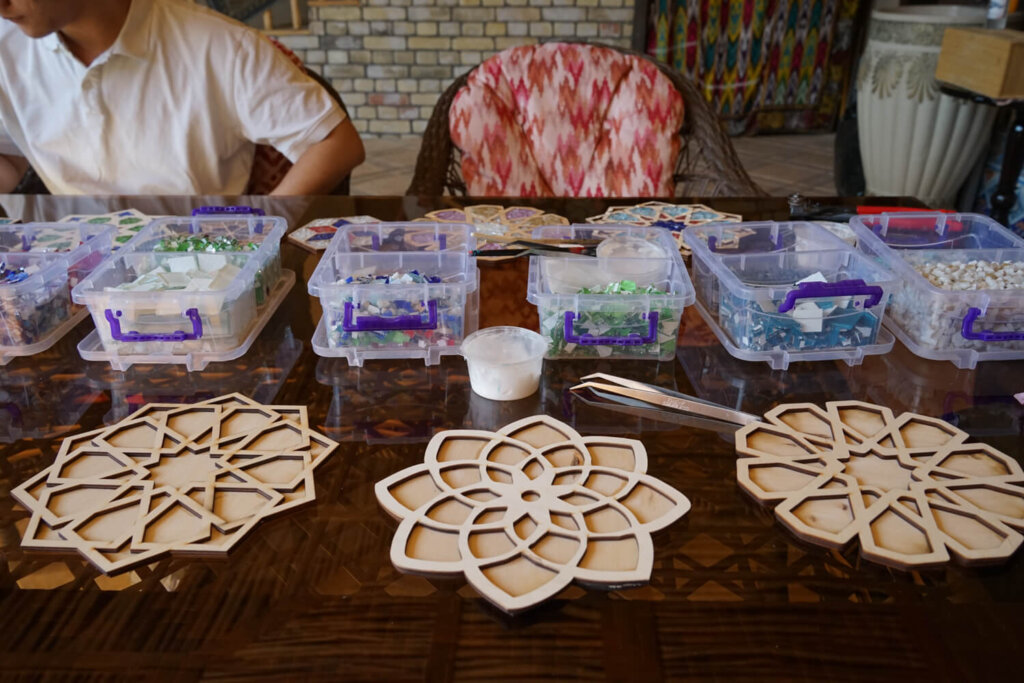
Azamat helped us select our designs, giving us pointers on which patterns would be easier or more difficult to complete. The edges are the tricky part — rounded edges are generally a bit more forgiving, while sharp points with acute angles require much more precisely cut tiles to fill out the mold in a visually pleasing way.
And so naturally, despite this warning, I immediately chose a star-shaped design with an abundance of sharp angles, a decision I would come to regret… and then later be a bit proud of.
Then it came time to select the colors. With some suggestions from Azamat, I ended up going for shades of blue (dark blue and turquoise), as well as accent colors of green, red, and beige, a similar color palette to some of my favorite mosaics I had seen.
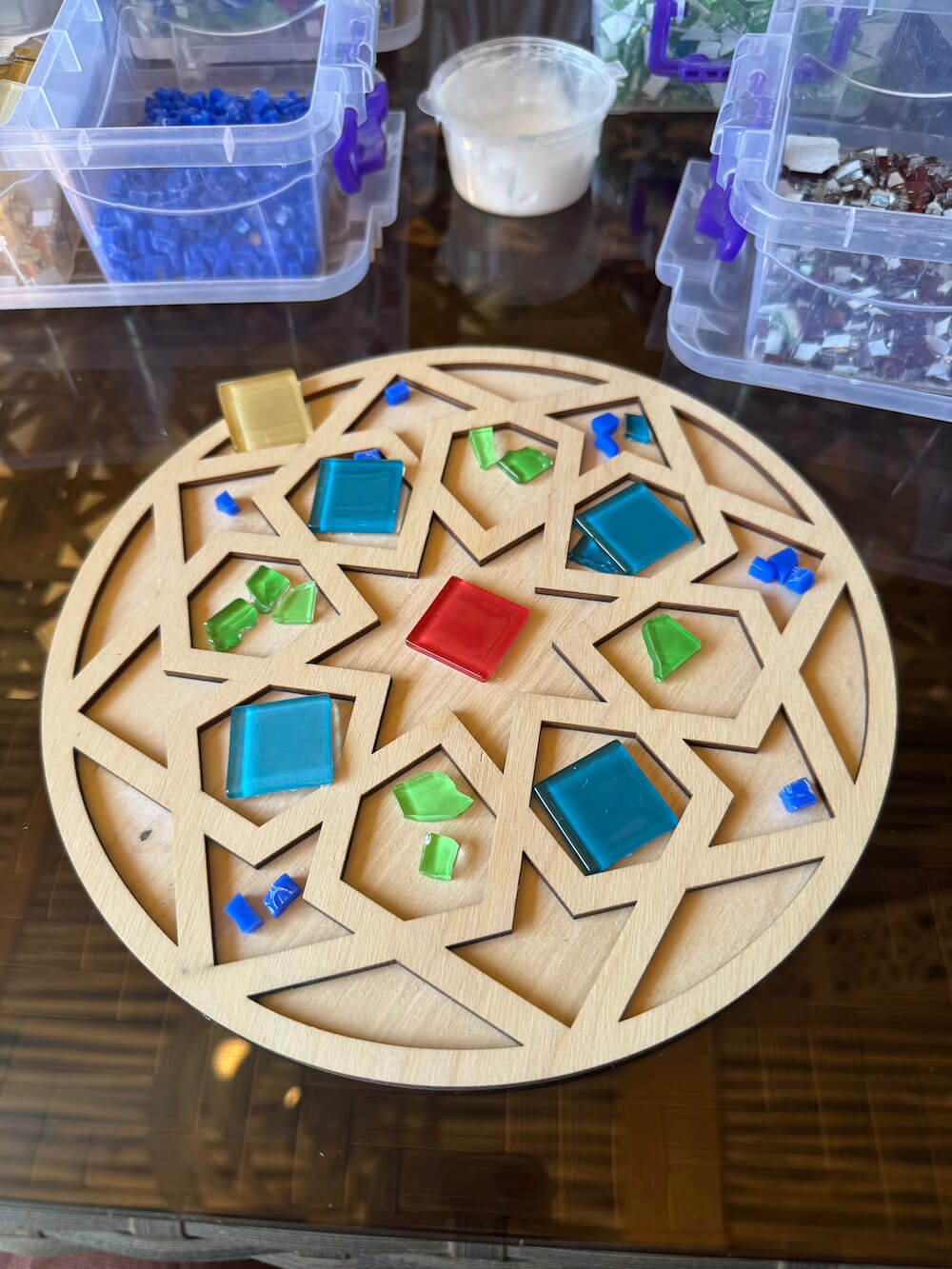
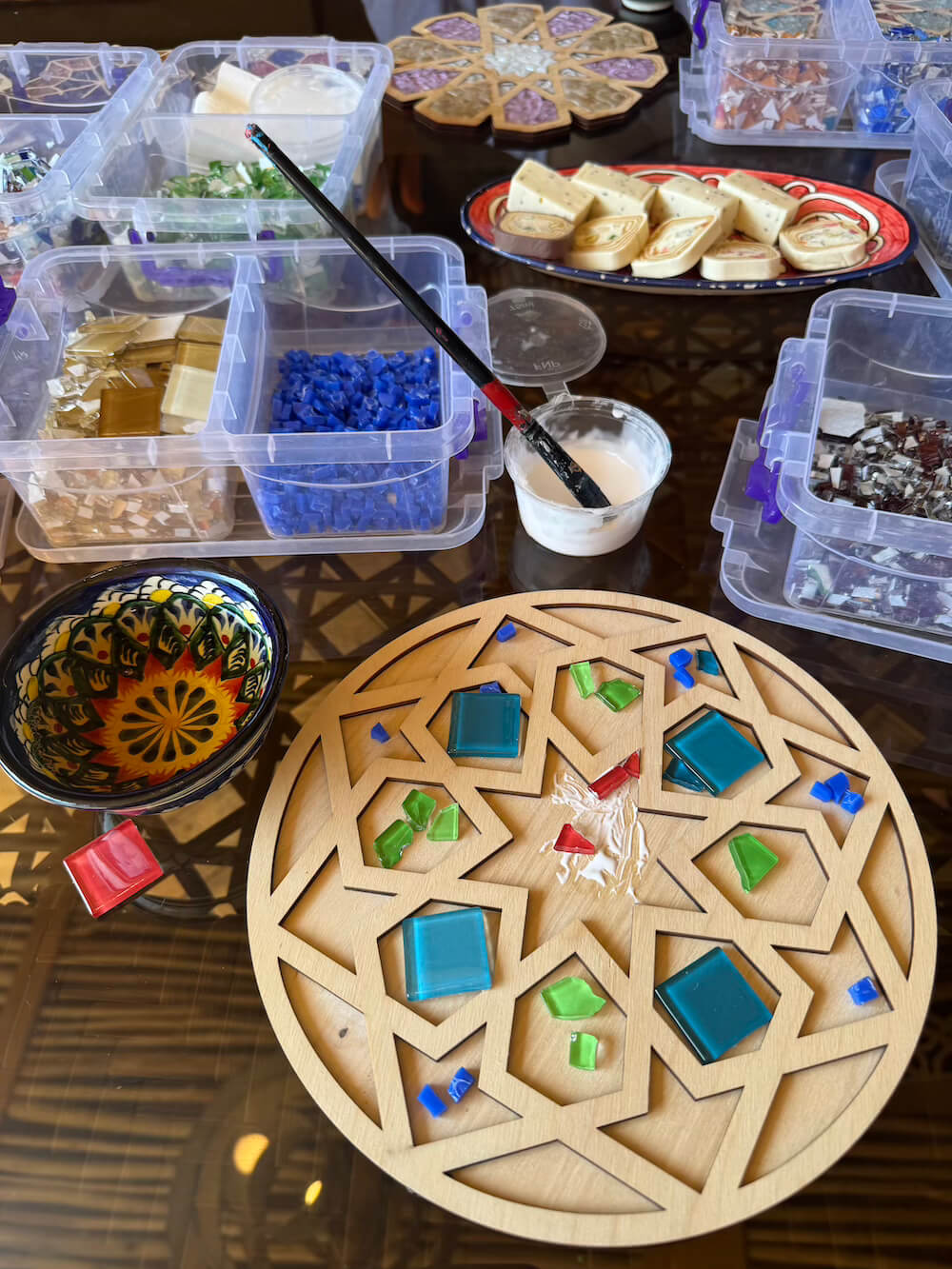
Then it was time to begin placing tiles! The process was oddly meditative, and only occasionally frustrating. It was nice to see the visual progress of the design emerging, but as I was warned, filling the corners proved very difficult. I tried not to obsess over every tiny gap and imperfection…. emphasis on tried!
By far the hardest part was cutting the glass, which is harder than it seems. Even with glass cutting tool, I was too afraid to cut the glass myself, so I left it to the professionals. Azamat was happy to step in and cut tiles for us to fit pieces we were missing. This allowed me to enjoy the creative side of the process without intrusive, Final Destination-esque thoughts.
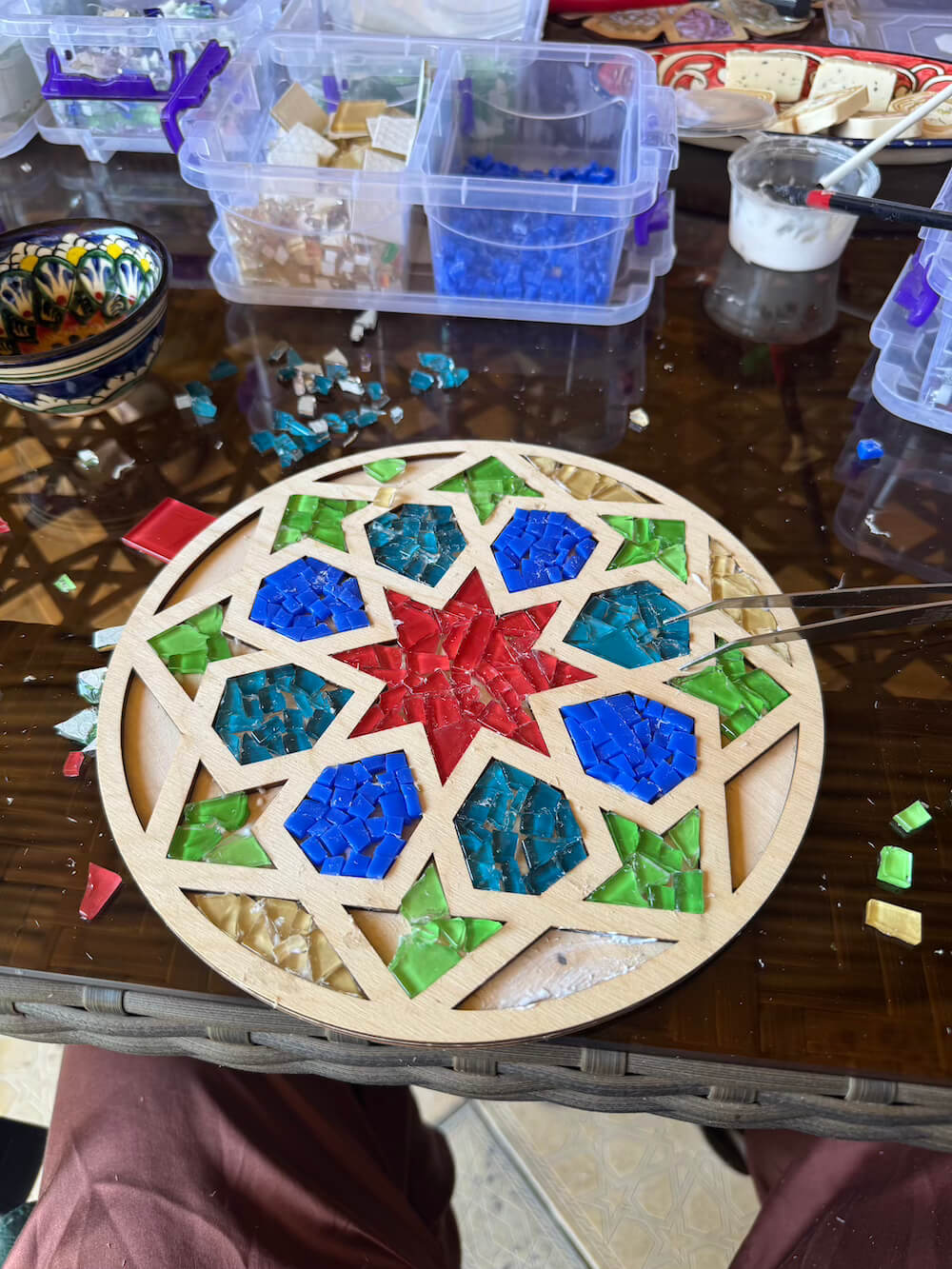
With his help, we could focus on arranging them into our designs and gluing them into place. It was fun, like completing a jigsaw puzzle that only we could see the final vision of in our minds.
While the perfectionist side of me looks at my mosaic art and sees all the gaps in it, when I step back and try to look at it objectively, I’m rather proud of the art I was able to create in such a short time and how it brings back a really fond memory of Samarkand, the city I most enjoyed in Uzbekistan.
Is It Worth Taking the Class?
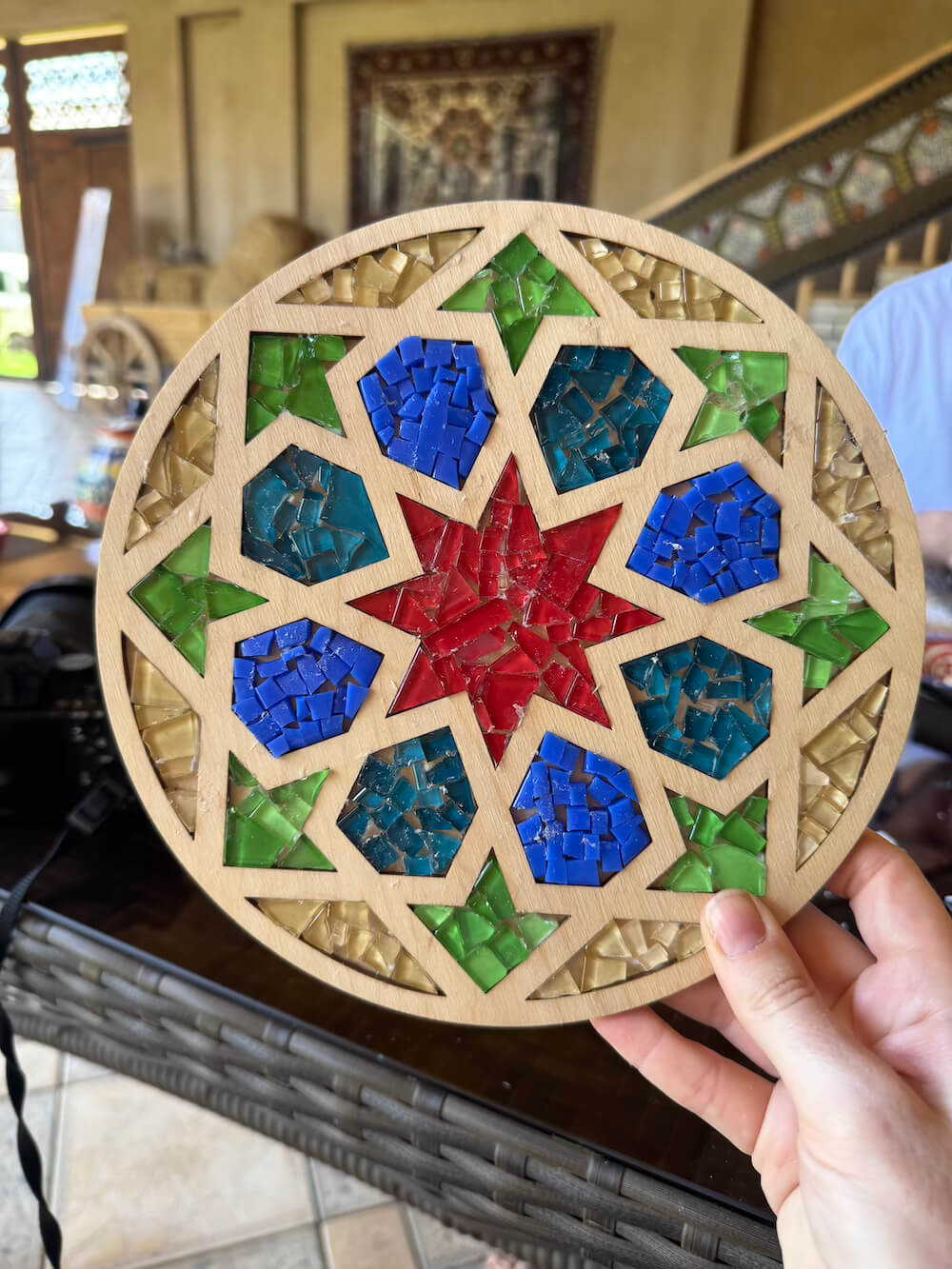
I took several crafting classes in Uzbekistan — wood carving in Khiva, suzani embroidery in Bukhara, and mosaic making in Samarkand. This was probably my favorite craft project that I came home with, because I felt the most ownership over it.
While I learned so much in the suzani embroidery class, I also didn’t really walk away with a piece I had finished (or felt capable of finishing), because the design was so large and the time investment needed was too high. I liked being able to have a complete souvenir ready to take home with me.
I also learned a lot about the art of mosaics and how the Timurid empire, exemplified through the mosaics, shaped the city of Samarkand. It felt so fitting to take a mosaic class in a city so defined by its mosaics, and I’m really glad I spend a morning in Samarkand taking this class!

Allison Green is a former teacher who has been travel blogging since 2016, visiting 75+ countries in total. She has a Masters in Teaching and a B.A. in English and Creative Writing. As a former educator, she merges her writing and educational experience to encourage ethical, sustainable travel. She has been a speaker at the World Travel Writers Conference and TBEX. Her writing, photography, and podcasting work has appeared in National Geographic, CNN Arabic, CBC Canada, and Forbes, amongst others. When she’s not on the road, she lives in Bangkok, Thailand.
What a wonderful experience! Learning a traditional craft is one of the best ways to connect with a destination, and your article beautifully captures the artistry behind Uzbek mosaics. Thanks for sharing such an inspiring cultural experience!
Thank you for your kind words Edward 🙂 I thought the same!