

Wood Carving Class in Khiva: Crafting in the Minaret’s Shadow
One of my favorite memories of Khiva takes place in an odd location: sitting at a folding table covered by a blanket, sheltered from the street’s view by a fluttering wall of suzani embroidery, learning from a woodcarving master.
Behind the suzani wall, the Islam Khoja Minaret stood above us, and countless travelers passed us by, unaware we were even there… except for the occasional curious child’s face that would pop up, parting the suzanis to peek behind the curtain.
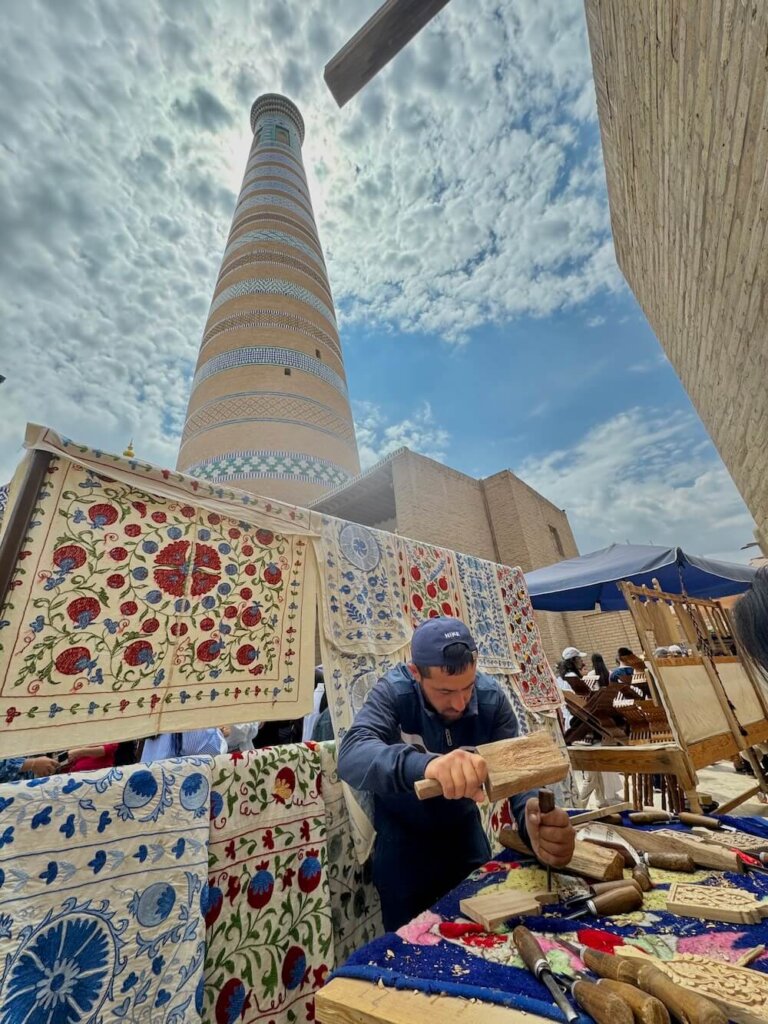
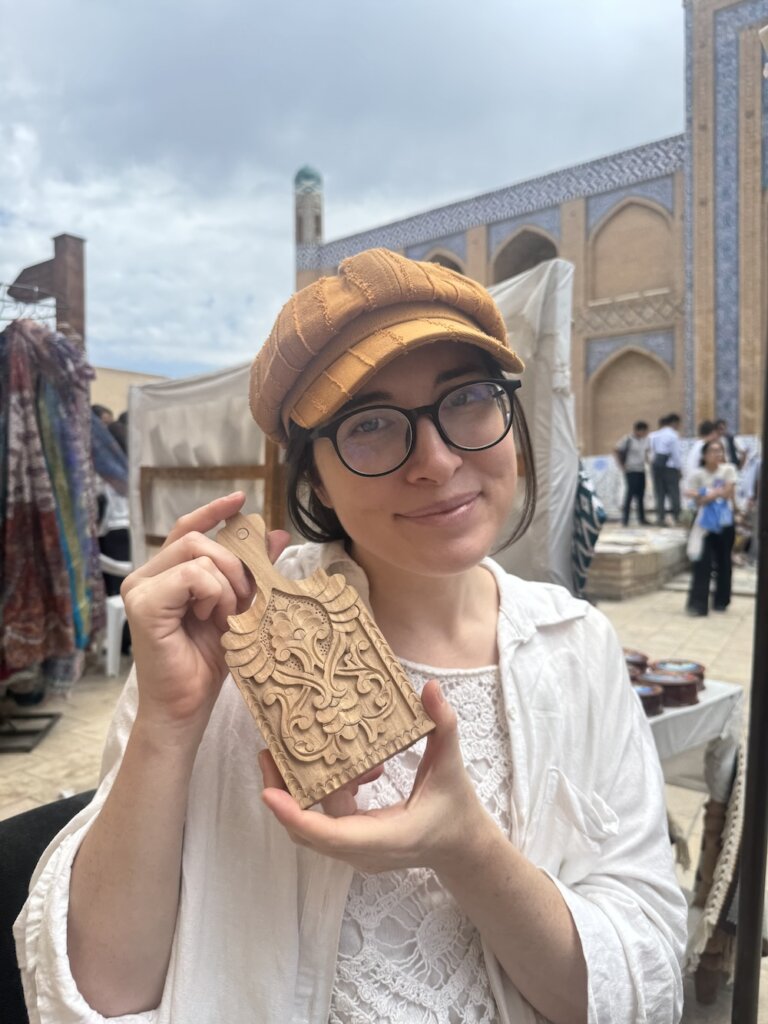
It was a really fun way to spend about an hour and a half learning an Uzbek handicraft, and I loved being able to take home my own little piece of art that would always remind me of Khiva.
Although I almost certainly have zero future in woodworking (as I needed all the help I could get), I still really enjoyed the experience.
| 🇺🇿 Planning Khiva at the last minute? Here are some tips! 🕌 Top Khiva Tours & Attractions 1. Historical Walking Tour of Khiva (#1 pick — my guide was great) 2. 4 Ancient Fortresses Day Tour (see the historical region outside of Khiva — can also do en route to Nukus, if visiting. This is what I did.) 3. 1-Hour Bread Master Class (make bread the traditional Uzbek way, in a tandir!) 🏨 Top Khiva Hotels 1. Khiva Siyovush Hotel (stayed one night, gorgeous mid-range boutique hotel inside the city walls) 2. Madrasah Polvon-Qori (friend stayed here & loved, boutique hotel in a 19th century madrasah, just outside of the East Gate to Itchan Kala) 3. Oqilanur Guest House (stayed one night, located inside the city walls, charming budget guesthouse) 🚆 TIP: Book your train tickets ahead of time, especially if taking the sleeper train from Tashkent! Train tickets often sell out on the official Uzbekistan train website (and the website is glitchy). You can buy them at a small up-charge on the 12go.asia site — it will be much cheaper than going through a travel agent. |
This guide is going to explain a bit about what to expect during this woodworking class in Khiva — including the process of making a wooden souvenir, what you’ll learn, and a comparison to this woodworking class to other craft classes I did in Uzbekistan.
Overall, I really enjoyed the woodworking class in Khiva that I took and would definitely recommend it to travelers interesting in creating their own souvenirs, especially one that is so specific to Khiva itself and what the city is known for. Here is what you should know before deciding if this is the right woodworking class for you!
Booking the Woodworking Class
Whenever I am traveling abroad I use Get Your Guide to look through guided experiences, cultural workshops, and day trips. I like their 24-hour cancellation policy because my plans frequently change when I travel and I enjoy having the freedom to change my mind as my trip progresses and I assess my schedule.
I knew that Khiva was famous for its woodworking and I wanted to see if there was a class about woodworking and found this workshop. I asked my friend if she wanted to join and we decided to do it!
The one downside about this workshop is that it requires a minimum of three participants to run. Since it was just me and my friend, we booked for three people anyway, even though we were only two attending.
This meant we both ending spending about ~$36 USD per person, rather than the $24 USD listed on the site. I was okay with that since we got a fully private lesson, and I thought it was still quite good value.
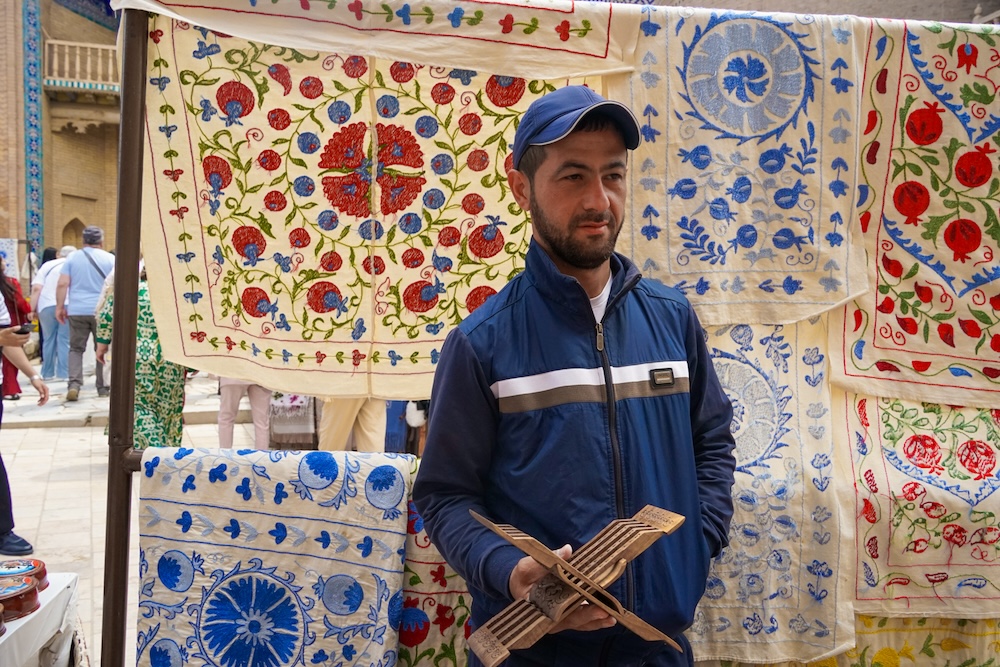
The day before our tour, we received a text with information on where to find our guide as well as a photo of him to help us find him. However, it was still a little tricky to find him as this is a really crowded area of Khiva! After a bit of confusion, we did end up finding him, and our workshop began just a few minutes past the scheduled 11 AM start time.
There are three time slots offered: 11 AM, 4 PM, and 5 PM. I imagine this is because this workshop takes place outside and they want to avoid the hottest hours of the day (Khiva is really hot!). Even at 11 AM, it was still rather hot, especially because woodworking takes some effort.
So keep this in mind — you will probably want to wear a hat and sunscreen / long sleeves in order to protect yourself from the UV at this time of day!
What the Woodworking Class Is Like
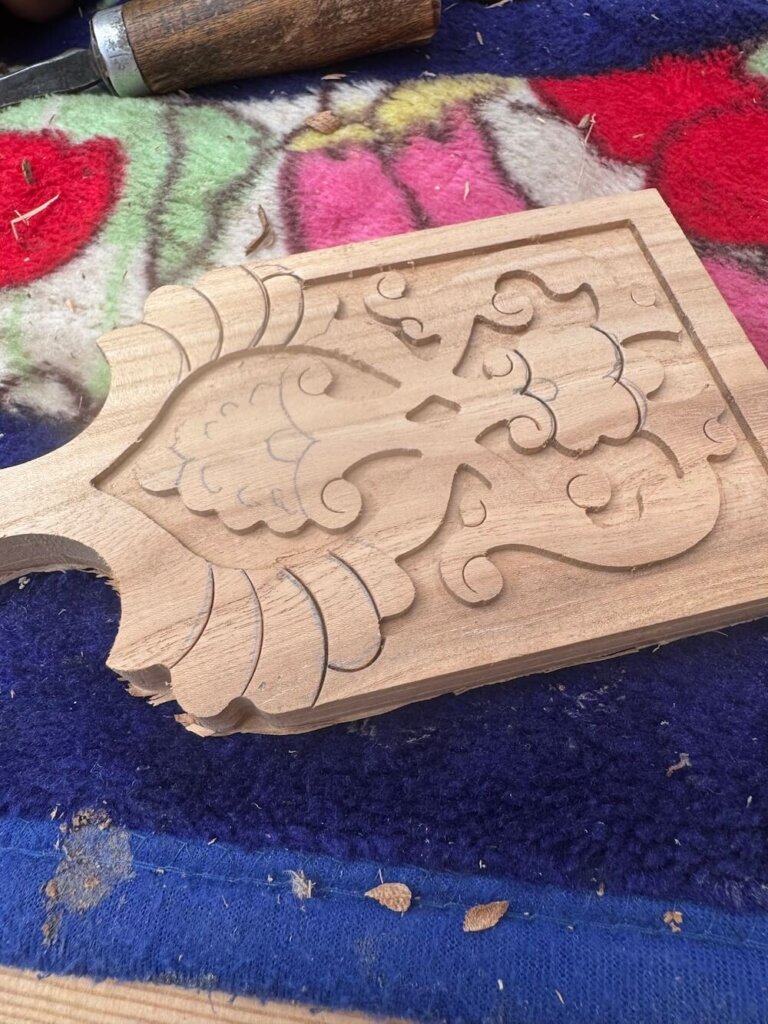
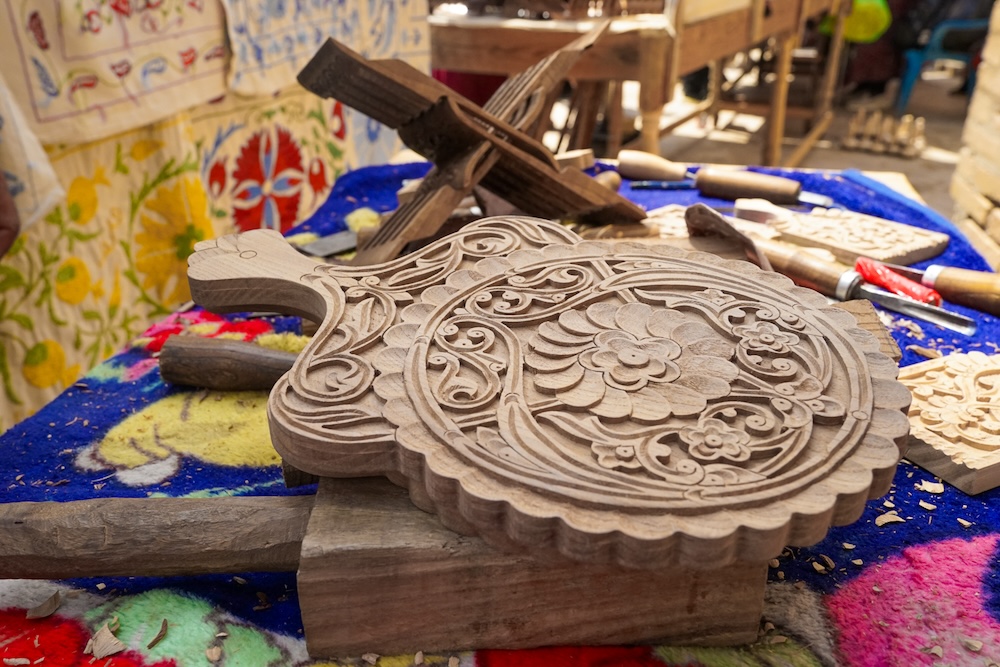
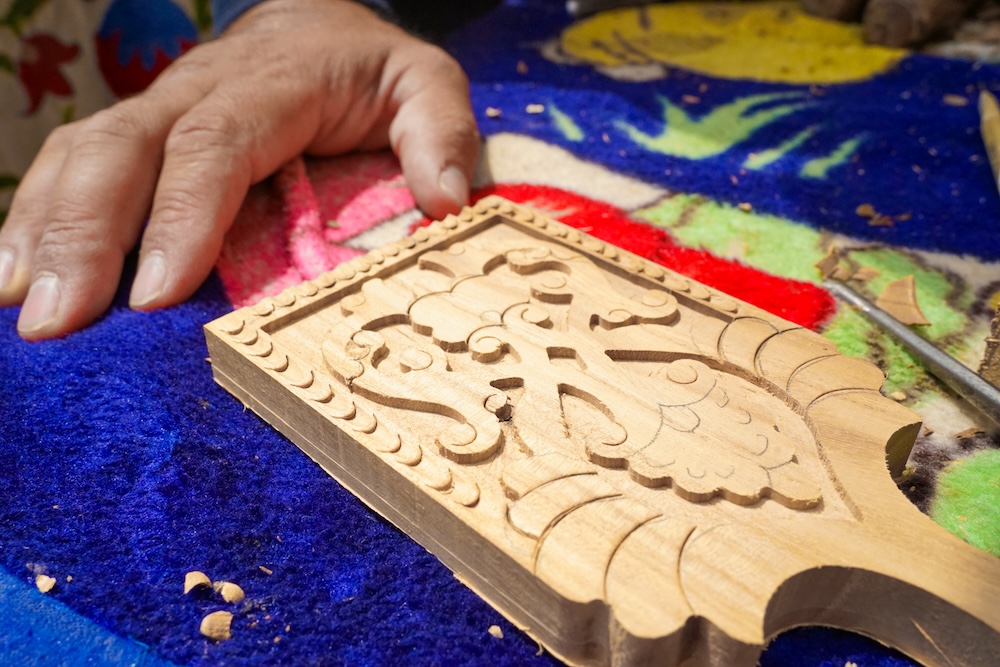
The woodworking class starts with a blank slate: a pre-cut piece of wood cut roughly into the shape of the mini cutting board you’ll be working on. You won’t do this part; rather, you’ll be responsible for the more fun part: the carving and detailing!
The guide will hand draw a design in pencil on the wood and then you will follow the lines with a series of tools in order to create the famous Khiva floral and swirl patterns.
The tools themselves are really cool: a collection of semi-circular metal chisels, sort of shaped like parentheses, in various sizes. There are also specialized tools for punching small holes and others for carving decorative ridges and grooves into the surface.
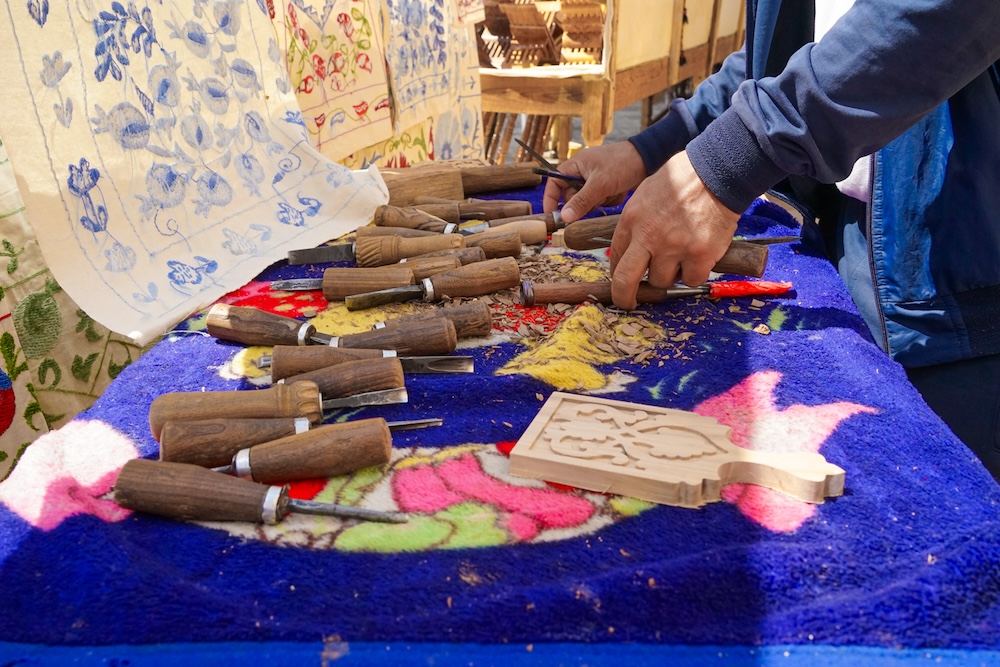
You can use the same tool in different ways for different effects: in the case of the semi-circular chisels, you can hammer it straight down to create a clean, deep cut, or drive it through at an angle to shave away a few layers of wood smoothly. You will mostly use these tools, changing size based on what works best for the design drawn in pencil.
However, it is definitely not as easy at it seems! We needed to see quite a few demonstrations of what was being asked of us to do, and it wasn’t always very clear what the next step was. Umid ended up having to help us quite a bit.
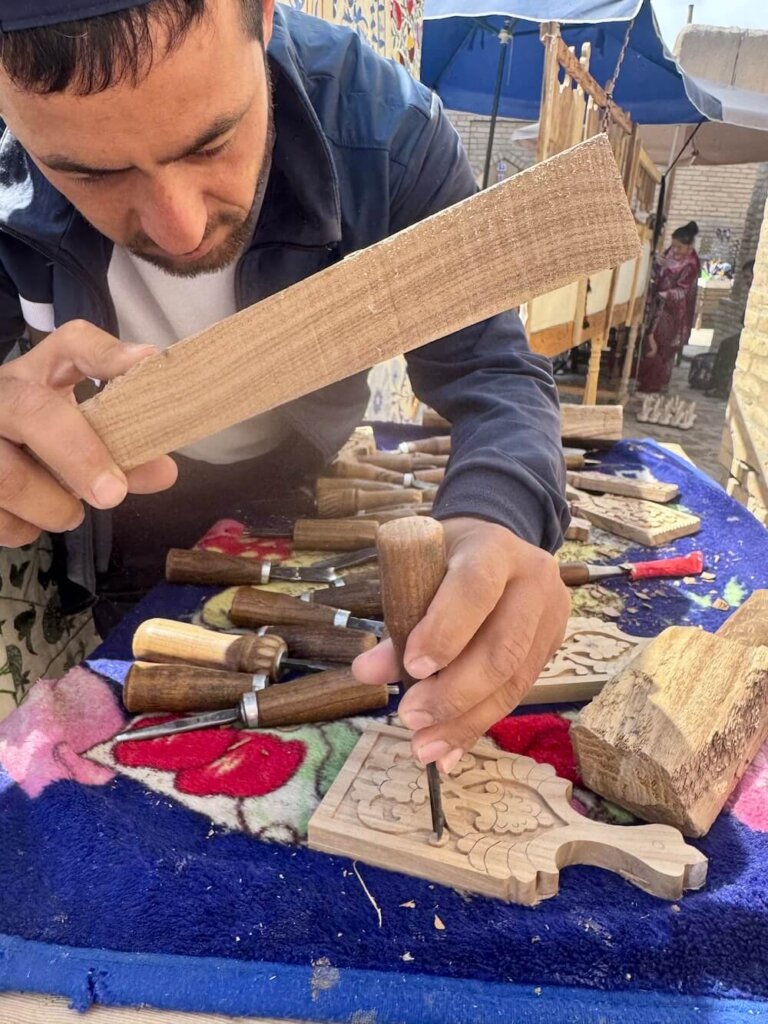
While it’s definitely partly due to my lack of visual creativity, I think it was also partly due to the fact that our woodworking master — while very sweet and talented — had an extremely limited command of English.
This is true of many master artisans, and it’s fine: they have expertise in other areas! However, other workshops I took later on during my trip to Uzbekistan included a multilingual guide and interpreter in addition to the master artisan. These workshops were more expensive but offered a lot more value in the sense of walking away with a more rich understanding of the craft, its history, and the artisan themself.
That said, this workshop is a good deal cheaper than the other tours I took. If you have limited time on your trip and you want to take other Uzbek craft workshops — such as learning suzani embroidery, mosaic making (I took this class — peep me hard at work in the second photo!), knife crafting, or miniature painting — there is another company that organizes more guided and comprehensive crafting workshops, but be aware that they are more expensive.
Is It Worth Taking a Wood Carving Class in Khiva?
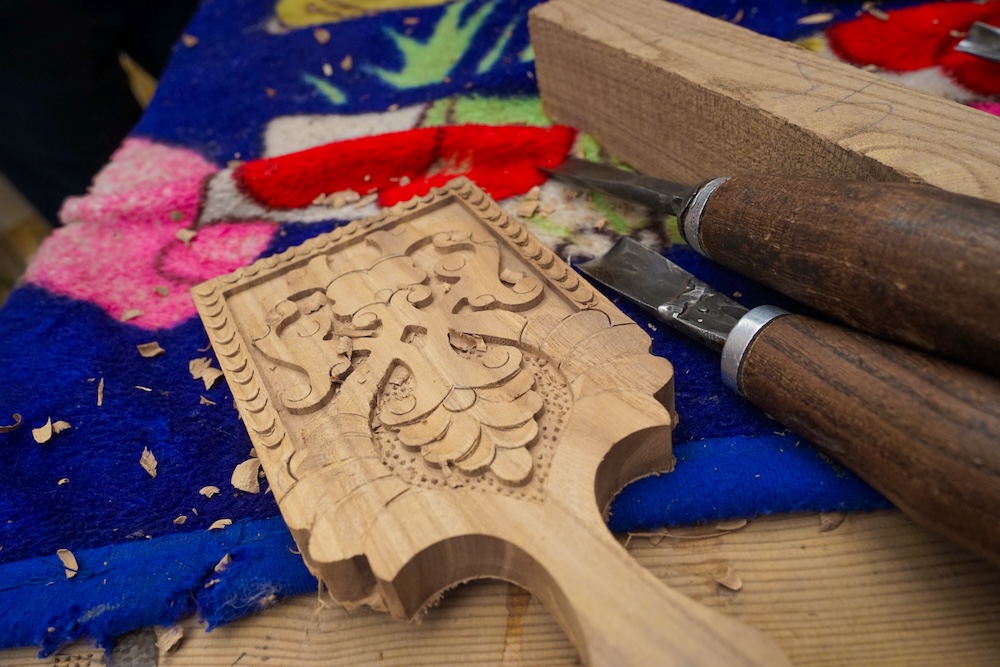
As I laid out above, there are definite pros and cons to taking this wood carving class. For me, here’s how I look at it.
The pros are: it’s rather affordable compared to other crafting workshops, it’s the only wood working class you can currently pre-book, and I really liked the outdoor setting beneath the minaret (though some people might prefer to be indoors due to the heat, this was a pro for me!).
The cons are: you really don’t learn too much about the history of wood carving due to the language gap. As there is no interpreter provided, you have to learn about it later. It also made instructions a little more confusing. While I still ended up with a cool wood carved craft, it was definitely more of a collaborative effort, because I needed quite a lot of help from the guide to make my piece because the verbal instructions were lacking.
I hope this gives you a balanced account of what it’s like to take this particular wood carving workshop in Khiva. I still really enjoyed the experience, despite the cons I laid out, but it’s up to you on how you think your time will be best spent in Khiva.
Personally, I think Khiva is a very small city whose main sites in the Old City (Itchan Kala) you can easily exhaust in just a day. You likely will have extra time in Khiva, especially because the city takes so much time and effort to get to! I think it’s worthwhile to fill that time with some crafting and cooking workshops. I also did an Uzbek bread workshop, which I’ll be writing about soon, but you can also learn to make their signature dish, shivit oshi.
If you don’t particularly care to take it in Khiva, but you do want to take a woodworking class, the craft workshop company I liked best also offers a wood carving workshop in Bukhara, although Bukhara is not particularly known as the home of wood carving. However, this company currently doesn’t offer a workshop in Khiva.

Allison Green is a former teacher who has been travel blogging since 2016, visiting 75+ countries in total. She has a Masters in Teaching and a B.A. in English and Creative Writing. As a former educator, she merges her writing and educational experience to encourage ethical, sustainable travel. She has been a speaker at the World Travel Writers Conference and TBEX. Her writing, photography, and podcasting work has appeared in National Geographic, CNN Arabic, CBC Canada, and Forbes, amongst others. When she’s not on the road, she lives in Bangkok, Thailand.