


Is Visiting Sweden’s IceHotel 365 Worth It? [2026-2027 Update]
When I planned a visit to Sweden to see the fall foliage in Abisko National Park (one of my favorite places in Sweden) it almost slipped my mind that you could visit Jukkasjärvi’s indoor ice hotel any time of year. Even on bright, sunny, (relatively) warm autumn days… or even under the midnight sun!
That’s right: Sweden is home to the world’s first year-round ice hotel. Since its creation, a few other ice hotels have offered a smaller year-round ice hotel experience, like Kemi’s SnowExperience365… which definitely didn’t do much in the way of creativity when it came to naming it.
| 🇸🇪 Planning a last-minute trip to Jukkasjärvi and Kiruna? Here are my quick picks! ❄️Best Winter Activities – Northern Lights Photography Tour (includes professional photographer photos) – Dog Sledding Self-Drive Tour (fireside fika break with hot drinks included — there’s an afternoon tour and also a morning tour) – Snowmobile Tour with Coffee Break (explore the river valley and off-road areas) 🛌 Best Places to Stay in Jukkasjärvi & Kiruna Jukkasjärvi: Reindeer Lodge (budget-friendly and Sámi-owned) Jukkasjärvi: Ice Hotel (the O.G. snow hotel, with warm rooms & ice rooms) Kiruna: Aurora River Camp Glass Igloos (only glass igloos in this part of Sweden) Kiruna: Camp Ripan (stylish chalet style accommodations, with restaurant + spa!) |

While the actual ice hotel itself that is rebuilt annually would not open until December 12 that year, I still personally feel that I was able to get the full ice hotel experience in the middle of September… once I entered the building, at least.
Honestly, I was extremely impressed by how expansive and detailed the Icehotel 365 was for an off-season ice hotel. To be honest, it was still larger and way more impressive than some actual ice hotels I’ve seen in the past. It’s a whopping 2,100 square meters, and every inch is detailed with artistry.
My Experience Visiting Icehotel 365

Since I was staying nearby at the Reindeer Lodge, which I absolutely adored so much that I wrote about it (and I rarely find time to write about places I stay at!), I didn’t stay overnight. Instead, we just visited during the daytime.
Although I’ve visited lots of ice hotels, I’ve never really been interested in staying in one overnight because I already struggle with falling asleep… being in literal freezer temperatures wouldn’t help with that, I don’t think.
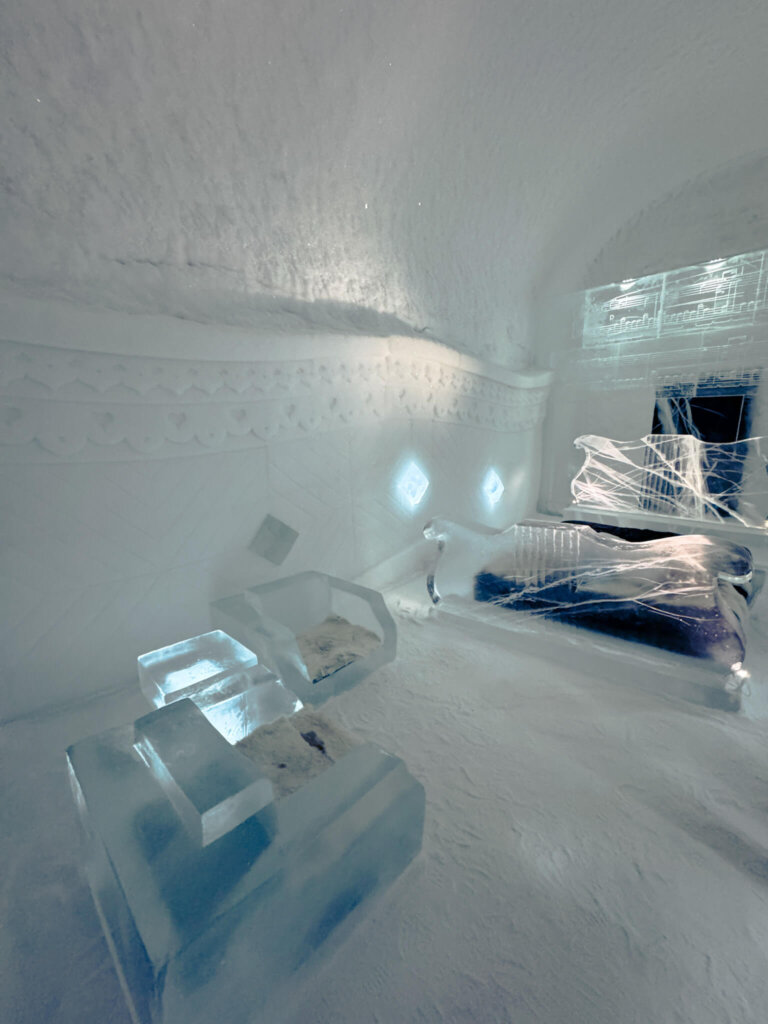
Even without spending the night, I was thrilled with my visit to Icehotel 365. The ice sculptures and artwork alone are worth the trip! All year round, you can walk through 18 different art suites, each created by a different artist with its own theme.
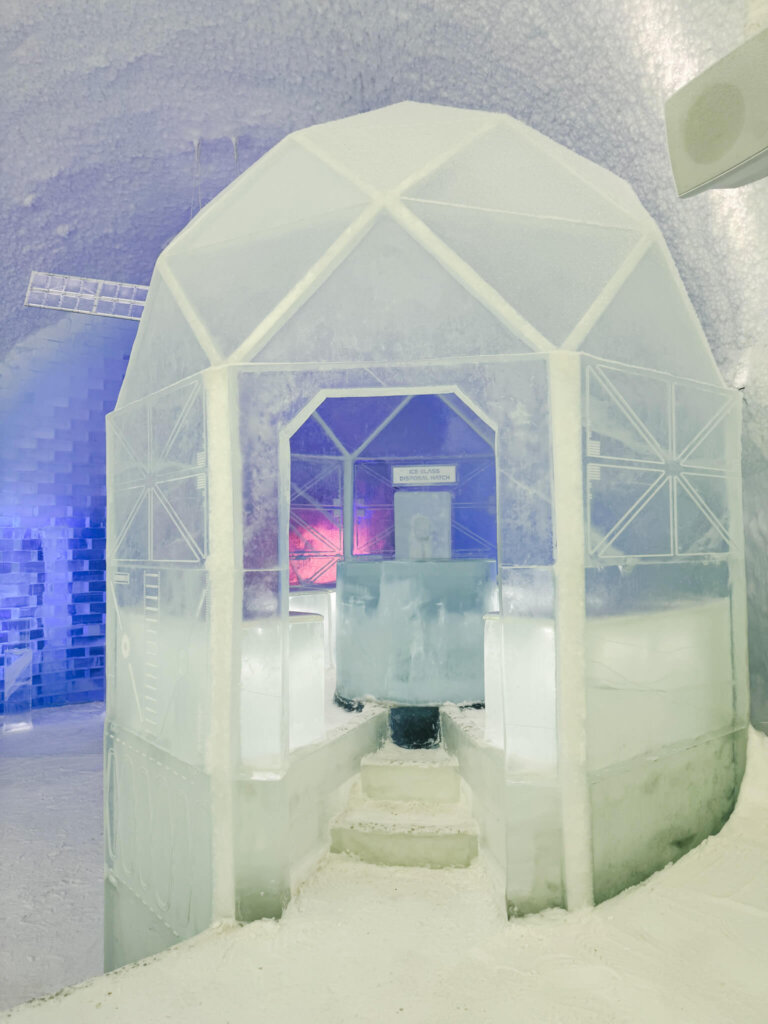
You’ll also get to explore the main ice lobby (which was space-themed during my visit) and order a drink at the ice bar, served in an ice glass of course! — though note that drinks aren’t included in the price of your ticket.
We also came back to Icehotel 365 to eat at their restaurant as there aren’t many food options in town. I have to be honest here: the on-site restaurant is… not great. Honestly, I struggle to even say it was good. Both me and my friend really did not like our meals, and I am generally a really easygoing diner.
Is It Worth Visiting?

I won’t make you read to the end of the post to give you the obvious answer: yes, visiting Icehotel 365 — in any month of the year — is absolutely worth it!
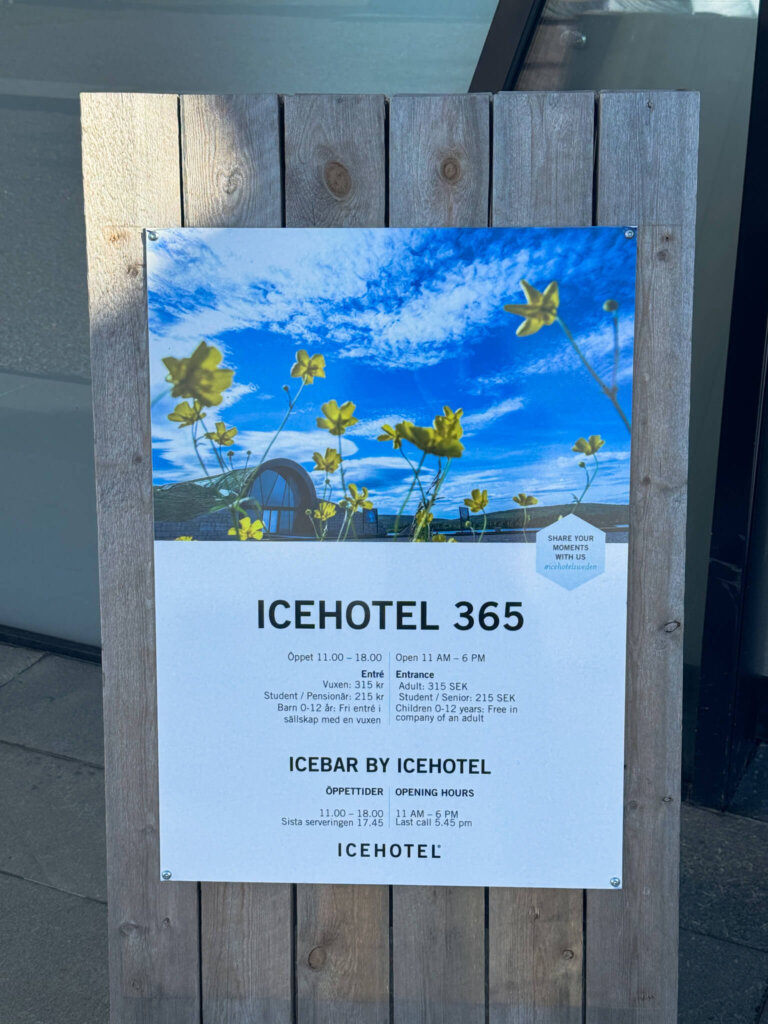
If you just do a daytime visit of the IceHotel 365, it’s a pretty inexpensive experience when it comes to the cost of activities in general in Scandinavia. In the off-season, it costs 315 SEK to visit, about $33 USD.
For everything you get to experience, I’d say it’s totally worth the price. There’s something quite magical about stepping out of a snow hotel into the endless glow of the midnight sun, or in my case, the fall colors and soft golden light of the Arctic autumn afternoon.
In the high season, the prices are a little more, but you do also get to visit the seasonal ice hotel that is rebuilt from scratch each year, which is really amazing.
During the winter period once the full ice hotel is built and in place, tickets are 395 SEK ($42 USD) but like I said, your ticket includes a whole separate structure to also explore, so it’s absolutely worth the extra cost.
Is It Worth Staying Overnight?

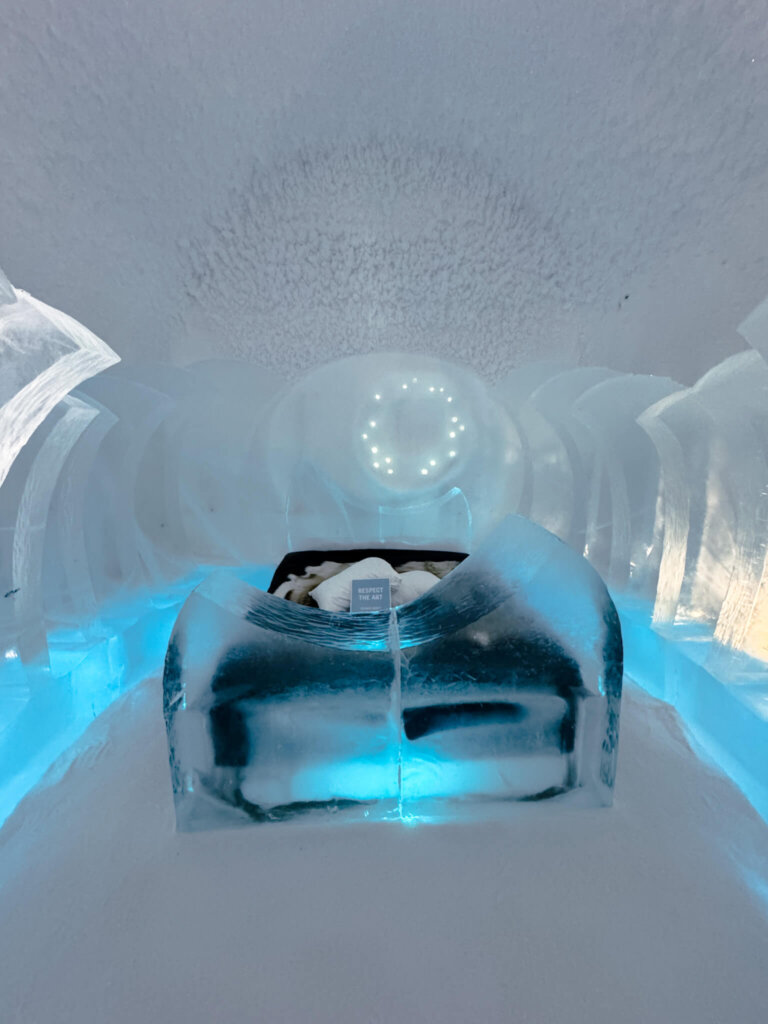
If you’re dreaming of a night in an ice hotel but not the peak-season price tag, visiting in the off-season is the move. Rooms that go for around $750 USD per night in winter can drop to about $385 USD, ~50% off (you can check prices for your dates here). I’d say that’s a seriously cool deal, in both senses of the word!
However, you have to accept what staying in an ice hotel means. Namely, you will be sleeping on a literal block of ice. There is a mattress and reindeer hides to help keep you warm, as well as an expedition-style sleeping bag… but the ambient temperature of the cold rooms is between –5°C and –8°C, so your face absolutely will be cold.
Regarding bathrooms, there are a few suites that have their own (heated!) bathroom, but the majority of rooms do not (and the ones that do are $$$).

For the non-suite rooms without a bathroom, you will have to use the shared bathroom and shower area down the hall.
And if you really feel you need to warm up, you have free access to the sauna in the Riverside Lobby.
Whether or not it’s worth it, I can’t say definitively because it’s such a personal choice as to if you think you would be comfortable and be able to get a decent night’s sleep. For me, I think that comes down to how sleeping in one is on your bucket list vs. how much you just want to see one.
Check prices and availability at Icehotel here (be sure to look for ice rooms if that’s what you want — the other rooms are just standard guesthouse rooms)
Getting to Icehotel 365

There are a few ways you can get to Icehotel 365. We arrived by car as my friend lives in the Arctic and we were doing a road trip in her own personal car.
Coming with your own car definitely gives you the most freedom. If you’re visiting in the summer or autumn when you don’t have to worry about snow, there’s really nothing to worry about in terms of the roads, as they’re very easy and straightforward. Driving in the winter, though, should only be undertaken by highly experienced winter drivers.
Most often, people will be flying into Kiruna. There, you can easily rent a car at the airport from a few different agencies. Alternately, if you are taking the train (perhaps from Stockholm) up to Kiruna, at the train station you can rent from the Sixt Car Rental on-site.

One key difference to note about visiting in low season vs. high season: transfers.
Transfers are only available in the peak season, when it costs 295 SEK (about $31 USD) — unless you choose their epic dog-sled arrival option, which costs 9,495 SEK (about $1,050 USD for a sled that can fit up to four).
It’s actually genuinely not a bad deal especially if you’re a family of four, as most dog sled tours cost $200-250 per person, and it lasts for 75 minutes, which is a lot more generous than other dog sled tours.
If you visit during the low season and aren’t coming with a car, you can take a taxi or the 501 bus (it leaves from the Kiruna bus station but is rather infrequent).
I can’t confirm a taxi quote with the company, but Rome2Rio estimates it at $55-70 USD one-way, which seems accurate based off my previous taxi costs in the Nordics.
You can also book a guided tour from Kiruna, but it is rather expensive. For example, there’s this tour, priced at €158 / $184. The cost of activities is about $42 for the ice hotel and $25 for the museum, meaning the transfer and guide cost is about $117 per person.
If you are a solo traveler, this is definitely a better price than taking a taxi on your own. However, as soon as you have two or more travelers, it will almost certainly be a better price to book your own taxis, as long as they are available.

Allison Green is a former teacher who has been travel blogging since 2016, visiting 75+ countries in total. She has a Masters in Teaching and a B.A. in English and Creative Writing. As a former educator, she merges her writing and educational experience to encourage ethical, sustainable travel. She has been a speaker at the World Travel Writers Conference and TBEX. Her writing, photography, and podcasting work has appeared in National Geographic, CNN Arabic, CBC Canada, and Forbes, amongst others. When she’s not on the road, she lives in Bangkok, Thailand.